Table of Contents
The History and Purpose of the State of the Union Address: Democracy’s Annual Theater
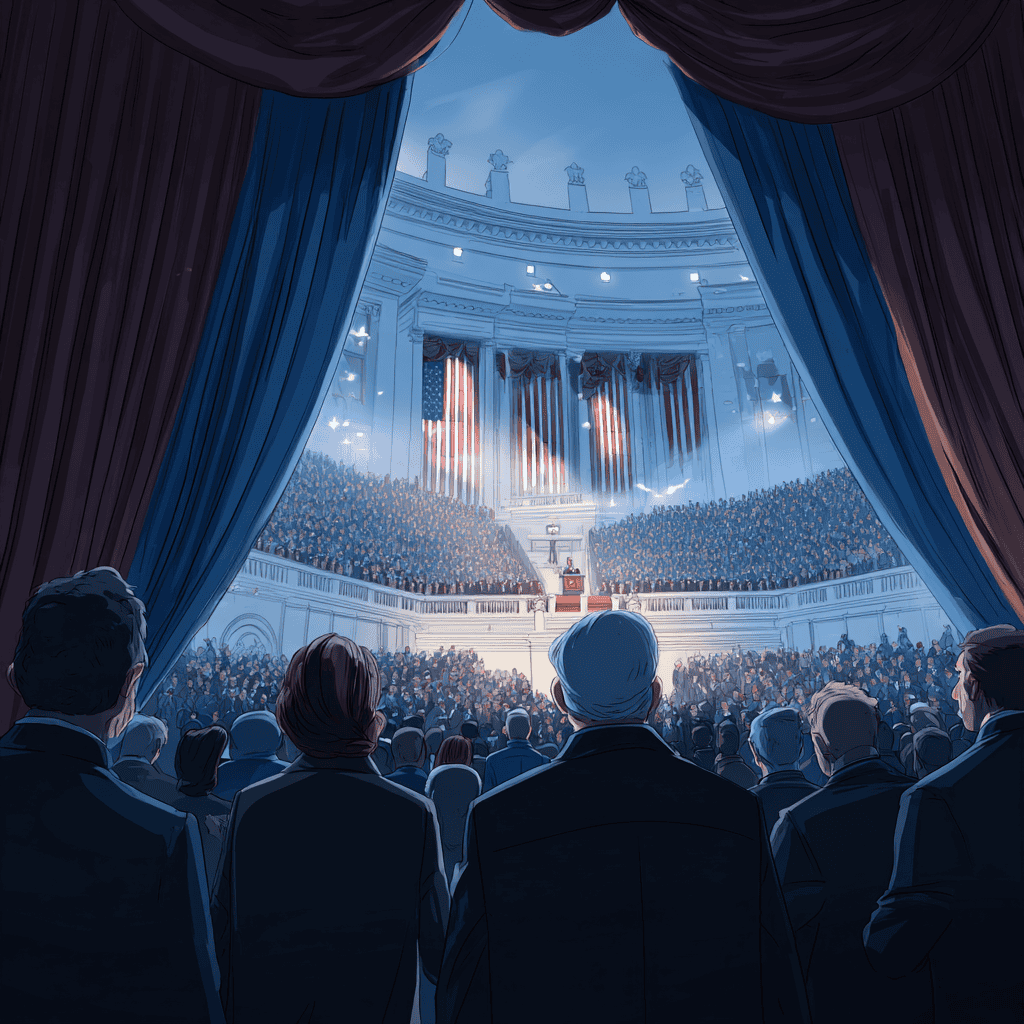
Once a year, in a ritual as carefully choreographed as any Broadway production, the most powerful figures in American government gather in the House chamber for the State of the Union address. The President enters to thunderous applause, shaking hands along the center aisle in what has become known as the “grip and grin.” Supreme Court justices sit stoically in their robes. Military chiefs display studied neutrality in full dress uniforms. Members of Congress perform partisan theater—standing and applauding or sitting stone-faced depending on the line and their party affiliation. And across the nation, millions of Americans watch this peculiar blend of constitutional duty, political theater, and democratic symbolism.
The State of the Union address has evolved from Thomas Jefferson’s written reports delivered by messenger to today’s multimedia spectacles complete with special guests, live fact-checking, and viral moments. This transformation reflects not just changing technology but fundamental shifts in how presidents exercise power, how Americans consume politics, and what we expect from democratic leadership. Understanding the history and purpose of this unique institution reveals as much about American democracy’s evolution as any constitutional amendment or political realignment.
Yet for all its pomp and circumstance, the State of the Union remains grounded in a simple constitutional requirement that presidents inform Congress about the nation’s condition. How this modest duty became prime-time political theater—and whether this evolution strengthens or weakens democratic governance—deserves careful examination. The address simultaneously embodies American democracy’s greatest strengths and most troubling tendencies, serving as an annual reminder of both our national potential and our political divisions.
Constitutional Origins and Early Interpretations
The Framers’ Intent
The Constitution’s requirement for presidential reporting appears almost as an afterthought in Article II, Section 3: “He shall from time to time give to the Congress Information of the State of the Union, and recommend to their Consideration such Measures as he shall judge necessary and expedient.” This brief mandate, sandwiched between presidential powers to convene Congress and receive ambassadors, provides no specifics about format, frequency, or content.
The vague language—”from time to time”—reflects the Framers’ uncertainty about executive-legislative relations in their new system. Having rejected both parliamentary fusion of powers and pure separation, they created ambiguous zones where branches would work out relationships through practice. The State of the Union requirement exemplified this approach: presidents must inform Congress, but how they do so would depend on evolving norms and political needs.
The provision served multiple purposes in the Founders’ design. It ensured legislative awareness of executive actions and national conditions, preventing the isolation that plagued confederate governance. It gave presidents a formal mechanism to propose legislation, acknowledging their agenda-setting role despite Congress’s lawmaking power. Most importantly, it required periodic communication between branches that might otherwise drift into mutual isolation or hostility.
Debates at the Constitutional Convention reveal little discussion of this provision, suggesting its inclusion was uncontroversial. The Framers likely drew from colonial and state precedents where governors regularly addressed legislatures. They also knew the British tradition of the King’s Speech from the Throne opening Parliament, though they surely wanted to avoid monarchical associations with whatever practice developed.
Washington’s Precedent
George Washington, acutely aware that his every action set precedents, delivered the first annual message to Congress in person on January 8, 1790. His brief speech—just over 1,000 words—covered foreign relations, military affairs, public credit, and education. Washington’s formal tone and comprehensive scope established patterns followed for centuries: the address as a sober assessment of national conditions rather than partisan argument.
The ceremony surrounding Washington’s address borrowed from British parliamentary tradition while asserting republican modifications. Washington traveled to Congress rather than summoning legislators to him, acknowledging legislative primacy in the constitutional order. Both houses prepared formal responses to the address, creating dialogue between branches. These exchanges, while respectful, established that Congress would not simply receive executive direction but would deliberate and respond independently.
Washington’s decision to deliver the address annually, though not constitutionally required, set an enduring precedent. Annual addresses created regular communication rhythms between branches and provided predictable moments for national assessment. This regularity helped institutionalize the young government and create public expectations for presidential leadership and accountability.
The first addresses also established the practice of using the occasion to articulate broad national vision beyond immediate policy proposals. Washington emphasized national unity, constitutional fidelity, and republican virtue—themes that transcended specific legislative recommendations. This dual function—practical and aspirational—would characterize State of the Union addresses throughout American history.
Jefferson’s Revolution
Thomas Jefferson’s decision to submit his first annual message in writing rather than delivering it personally marked a deliberate break with Federalist precedent. Jefferson believed Washington and Adams’s formal addresses too closely resembled the British monarch’s speech from the throne. Written messages, he argued, showed proper republican simplicity and avoided elevating the president above Congress.
Beyond symbolism, Jefferson’s approach reflected different theories of presidential power and legislative relations. Where Federalists saw presidential leadership as essential for energetic government, Jeffersonian Republicans emphasized legislative supremacy and limited executive power. Written messages acknowledged this hierarchy—the president reported to Congress rather than appearing before it as a co-equal or superior.
The shift to written messages also reflected practical politics. Jefferson, despite his many talents, was not a powerful public speaker. His thin voice and discomfort with public performance made written communication more effective. This personal limitation, transformed into republican principle, would govern practice for over a century, showing how individual personalities shape institutional development.
Jefferson’s written messages were read aloud by clerks in each house, maintaining some ceremonial character while removing the president’s physical presence. These readings often prompted immediate legislative responses, with committees forming to address presidential recommendations. The practice maintained executive-legislative communication while reducing the monarchical overtones Jefferson found objectionable.
The Evolution of the Modern Address
Wilson’s Revival and Its Implications
Woodrow Wilson’s decision to deliver his 1913 annual message in person revolutionized the State of the Union and symbolized broader changes in presidential power. A political scientist who had long advocated stronger presidential leadership, Wilson saw personal appearance as essential for mobilizing public opinion and pressuring Congress. His dramatic arrival at the Capitol, the first presidential appearance there for an annual message in 112 years, signaled a new era of presidential activism.
Wilson’s revival of oral delivery coincided with Progressive Era expansion of federal power and presidential responsibility. As government tackled complex economic and social problems, presidents needed tools to build public support for ambitious agendas. Personal addresses allowed presidents to speak directly to the people over Congress’s head, transforming a report to the legislature into a national conversation.
The response to Wilson’s innovation was mixed. Supporters praised the energy and leadership personal delivery provided. Critics saw dangerous aggrandizement of presidential power and violation of republican traditions. Some congressmen boycotted the address, viewing personal appearance as an insult to legislative dignity. These debates about presidential presence would recur throughout the 20th century as executive power expanded.
Wilson’s successors initially varied in their approach. Harding and Coolidge continued personal delivery, but Calvin Coolidge’s 1923 address became the first broadcast on radio, adding a new dimension to the tradition. Herbert Hoover, uncomfortable with public speaking, reverted to written messages. Not until Franklin Roosevelt would the oral tradition become firmly established.
FDR’s Transformation
Franklin Roosevelt transformed the State of the Union into its modern form through both style and substance. His addresses, delivered with characteristic confidence and flair, became major political events that shaped national conversation. FDR understood that radio allowed presidents to speak directly to citizens, making the address a tool for mobilizing public opinion rather than merely informing Congress.
Roosevelt’s addresses during the Depression and World War II demonstrated the power of presidential rhetoric to inspire and reassure during crisis. His 1941 “Four Freedoms” address articulated war aims that resonated globally. His 1944 call for an “Economic Bill of Rights” outlined an ambitious postwar vision. These speeches showed how State of the Union addresses could articulate transformative visions beyond immediate policy proposals.
The staging and dramatics of Roosevelt’s addresses set new precedents. He included personal anecdotes and emotional appeals alongside policy discussions. He acknowledged special guests in the gallery, personalizing abstract policies. He used simple, vivid language accessible to radio audiences. These innovations made the address more theatrical and accessible, if less formally dignified.
FDR also established the practice of using the address to claim credit for achievements while blaming Congress for failures. This partisan edge, while not entirely new, became more pronounced under Roosevelt. The address became a campaign speech delivered from the nation’s most prestigious platform, setting patterns that would intensify in subsequent decades.
Television and the Visual Presidency
Harry Truman’s 1947 State of the Union became the first televised address, though few Americans had television sets. By Eisenhower’s presidency, television was widespread enough that the visual elements of the address gained importance. Lyndon Johnson moved the address to prime time in 1965, maximizing television audience and transforming it into evening entertainment as much as political communication.
Television fundamentally changed the address’s character. Visual elements—the president’s appearance, gestures, and interactions—became as important as words. The audience’s reactions, particularly partisan standing ovations or pointed sitting, became part of the show. The presence of special guests in the gallery added human interest stories to policy discussions. The address became political theater where performance mattered as much as substance.
Ronald Reagan mastered the television-era State of the Union, using his actor’s training to deliver memorable performances. His innovation of acknowledging “heroes in the gallery”—ordinary Americans whose stories illustrated policy points—became standard practice. Lenny Skutnik, who rescued a drowning woman after a plane crash, became the first such guest in 1982, lending his name to all future gallery guests.
The television era also intensified partisan theater. Democrats and Republicans increasingly coordinated their responses—standing, sitting, applauding, or remaining silent in unison. These visual demonstrations of support or opposition became part of the message, showing national television audiences the political divisions over presidential proposals. The address became as much about watching Congress as listening to the president.
The Contemporary State of the Union
The Digital Age Transformation
The internet and social media have transformed the State of the Union into a multimedia, multi-platform event extending far beyond the actual speech. The White House now releases enhanced versions with graphics, creates social media moments, and provides fact sheets and supporting materials online. The address becomes content for countless tweets, memes, and viral videos, fragmenting and amplifying its message in unprecedented ways.
Live fact-checking has become a parallel narrative to the address itself. News organizations and partisan groups provide real-time analysis of presidential claims, creating competing interpretations even as the president speaks. Social media commentary creates a cacophony of responses that can overshadow the actual address. The unified national moment of earlier eras has given way to fragmented, polarized consumption.
Presidents now craft addresses with social media in mind, including short, tweetable phrases and memorable moments designed to go viral. The most successful lines are those that work as both television soundbites and social media shares. This pressure for viral moments can incentivize oversimplification or sensationalism over nuanced policy discussion.
Digital engagement also allows unprecedented public participation. Citizens can respond immediately, share reactions, and organize around issues raised in the address. The White House can track response in real-time and adjust messaging accordingly. This interactivity makes the address more democratic in some ways but also more susceptible to manipulation and misinformation.
The Opposition Response Evolution
The practice of formal opposition responses began with Republicans’ reply to Lyndon Johnson in 1966, evolving into an institutionalized rebuttal that follows immediately after the presidential address. This opposition response provides balance but also reinforces partisan division, framing the State of the Union as political combat rather than national assessment.
The challenge of responding to the president’s address from an empty room, without the pageantry and audience of the main event, has produced several memorable failures. Marco Rubio’s awkward water bottle moment in 2013 and Bobby Jindal’s widely panned 2009 response show the difficulty of matching presidential grandeur. These responses often receive more attention for gaffes than substance, becoming political liability rather than opportunity.
Multiple responses have proliferated as different factions seek to present their views. In addition to the official opposition response, there might be Tea Party responses, Progressive responses, Spanish-language responses, and social media responses. This multiplication of voices reflects political fragmentation but dilutes the impact of any single response.
The opposition response institutionalizes the partisan nature of what was once a more unifying event. By immediately reframing the president’s message through partisan lens, these responses prevent even momentary consideration of proposals on their merits. They transform the State of the Union from information delivery into opening argument in year-long political debate.
Theater and Symbolism
The contemporary State of the Union has become elaborate political theater where every element carries symbolic weight. The president’s entrance, traditionally triumphant, signals strength or weakness based on applause enthusiasm. The choice of who sits where—which Cabinet member stays away for continuity of government, which guests sit with the First Family—sends political messages.
Congressional behavior during the address has become increasingly partisan and sometimes disrespectful. Joe Wilson’s “You lie!” outburst during Obama’s 2009 healthcare address and Nancy Pelosi’s dramatic speech-tearing after Trump’s 2020 address exemplify the breakdown of traditional decorum. These moments, while shocking to some, energize partisan bases and generate fundraising opportunities.
The staging of bipartisan moments—brief instances where both parties stand and applaud—has become strategic political calculation. Presidents deliberately include lines designed to force opposition standing, making them appear obstructionist if they remain seated. These manufactured moments of unity mask deeper divisions while providing television footage of apparent national consensus.
Special guests have evolved from Reagan’s heroes to elaborate political props. Presidents now invite guests who embody every policy proposal, creating emotional arguments that bypass analytical scrutiny. Opposition parties bring their own guests to counter presidential narratives. The gallery becomes a competing showcase of American stories, each side claiming authentic representation of national values.
The Constitutional and Democratic Purposes
Informing the Nation
At its core, the State of the Union serves the fundamental democratic purpose of informing citizens about their government’s condition and direction. In an era of information overload, the address provides a unique moment when the president can claim national attention for extended discussion of multiple issues. This informational function, while transformed by modern media, remains essential for democratic accountability.
The comprehensiveness expected of State of the Union addresses ensures that presidents cannot ignore inconvenient issues or focus solely on strengths. The tradition of covering foreign and domestic policy, economic and social issues, creates pressure for balanced assessment. While presidents inevitably emphasize successes, the format requires at least acknowledging challenges across government’s full spectrum.
Modern presidents use the address to educate the public about complex issues that don’t typically receive sustained attention. Climate change, infrastructure needs, or entitlement reform might get detailed discussion in the State of the Union that they wouldn’t receive in normal news cycles. This educational function helps create informed citizens capable of democratic participation.
However, the partisan nature of contemporary addresses compromises their informational value. When every claim is contested and fact-checked, when opposition responses immediately reframe issues, citizens receive competing narratives rather than shared information. The address may inform, but it also confuses, leaving citizens to sort truth from spin.
Setting the Agenda
The State of the Union’s most practical function involves agenda-setting for the coming year. Presidents use the address to prioritize issues, propose legislation, and signal negotiating positions. This agenda-setting power shapes congressional calendars, media coverage, and public debate for months afterward.
The address’s agenda-setting power has grown as presidents have become chief legislators. Modern presidents arrive with detailed policy proposals, draft legislation, and specific requests for congressional action. The laundry list of proposals that characterizes contemporary addresses reflects presidents’ role as policy initiator rather than mere executor of congressional will.
Yet the relationship between State of the Union proposals and actual achievement remains tenuous. Studies show that presidents achieve only a fraction of their State of the Union requests, particularly in divided government. The address may set agendas, but it cannot guarantee action. This gap between presidential rhetoric and achievement contributes to public cynicism about government effectiveness.
The proliferation of proposals in modern addresses—sometimes dozens of specific items—dilutes focus and impact. When everything is a priority, nothing is. Strategic presidents increasingly use the address to highlight a few major initiatives rather than comprehensive catalogs, recognizing that focused messages more effectively drive action.
Rallying Public Opinion
Presidents increasingly use the State of the Union to mobilize public opinion for their agenda. By speaking directly to the nation, presidents can pressure Congress, shape public debate, and build momentum for their priorities. This “going public” strategy treats the address as the opening of a campaign for policy victory.
The effectiveness of presidential appeals varies with presidential popularity, issue salience, and political context. Popular presidents addressing consensual issues can generate significant pressure on Congress. Unpopular presidents facing skeptical opposition find their appeals fall flat. The address provides a platform, but it doesn’t guarantee persuasion.
Social media amplifies the potential for public mobilization but also fragments the audience. Presidents can no longer assume that most Americans watch the full address or receive its message unfiltered. Instead, they must craft messages that work across multiple platforms and survive partisan interpretation. This complexity makes rallying opinion harder despite improved communication technology.
The temporary nature of State of the Union influence limits its mobilizing power. Research shows that presidential addresses produce brief opinion “bumps” that quickly dissipate. Without sustained follow-up, State of the Union appeals rarely produce lasting opinion change. The address might start conversations but rarely concludes them.
Measuring Impact and Effectiveness
Policy Achievement
Tracking the relationship between State of the Union proposals and subsequent policy achievement reveals modest presidential success rates. Studies suggest presidents achieve roughly 40-50% of their specific State of the Union requests, with success varying by political context, issue area, and presidential skill.
Unified government dramatically improves presidential success rates, sometimes exceeding 70% for major proposals. Divided government reduces success to 20-30%, with most achievements involving bipartisan consensus issues. This variation highlights how the address’s effectiveness depends on political structure rather than rhetorical power alone.
Foreign policy proposals generally achieve higher success rates than domestic initiatives, reflecting greater presidential authority in international affairs. Economic proposals’ success depends heavily on conditions—crisis creates opportunities for dramatic action while prosperity breeds complacency. Social policy proposals face the toughest odds, given their controversial nature and complex implementation.
The timing of proposals within presidential terms affects their success. First-year addresses often achieve more as presidents enjoy honeymoon periods and electoral mandates. Final-year addresses become wish lists with little chance of achievement as attention shifts to succession. Mid-term addresses must navigate the changed dynamics following congressional elections.
Public Opinion Effects
State of the Union addresses produce measurable but limited effects on public opinion. Presidential approval ratings typically increase 2-3 percentage points after addresses, though these gains usually disappear within weeks. Policy-specific opinion movement is even more modest, rarely exceeding 5 percentage points on any issue.
The most successful addresses in moving opinion share certain characteristics: clear focus on one or two issues, concrete proposals rather than abstract principles, and connection to current events or crises. Scattered, laundry-list addresses produce minimal opinion change as audiences struggle to process multiple messages.
Partisan polarization increasingly limits the address’s persuasive power. Democrats and Republicans interpret the same address completely differently, with partisanship overwhelming message content. Independents, theoretically persuadable, increasingly tune out political speeches altogether. The universe of potentially influenced viewers shrinks each year.
Media coverage and interpretation matter more than the address itself for public opinion. How news organizations frame the speech, which moments they highlight, and what analysis they provide shapes public reception more than presidential words. Presidents increasingly cannot control their message once it enters the modern media ecosystem.
Historical Legacy
Some State of the Union addresses achieve lasting historical significance while most fade into obscurity. The memorable addresses typically involve major policy departures, crisis responses, or rhetorical innovations that transcend their immediate context.
FDR’s “Four Freedoms” address articulated principles that shaped the postwar international order. LBJ’s 1964 address launching the War on Poverty created programs that survive today. Reagan’s 1982 address introducing gallery heroes changed the format permanently. These addresses achieved lasting impact through vision, timing, or innovation.
Most addresses, however, are forgotten almost immediately. The lengthy catalogs of proposals, incremental adjustments, and partisan talking points that characterize typical addresses leave little lasting impression. Even presidents struggle to remember their own State of the Union proposals from previous years.
The paradox of the modern State of the Union is that increased frequency of presidential communication reduces any single address’s impact. When presidents spoke rarely, their words carried special weight. Now, with daily presidential statements, weekly addresses, and constant social media, the State of the Union becomes just another speech, albeit with fancier staging.
Criticisms and Reform Proposals
The Laundry List Problem
Contemporary State of the Union addresses have evolved into lengthy catalogs of proposals touching every conceivable issue. Recent addresses average over 6,000 words and last more than an hour, testing audience attention and diluting focus. This “laundry list” approach reflects political pressures to acknowledge every constituency and issue but undermines the address’s effectiveness.
The laundry list format emerged from several factors. Interest groups expect acknowledgment of their priorities. Congressional members want their legislative proposals mentioned. Agencies lobby for program recognition. Presidents fear that omitting any issue signals abandonment. These pressures create bloated addresses that satisfy insiders while boring general audiences.
Critics argue for returning to shorter, focused addresses that articulate broad vision rather than detailed proposals. A president might better serve democracy by clearly explaining two or three major initiatives than superficially mentioning dozens. Focused messages would be more memorable, actionable, and honest about presidential priorities.
Yet political realities make streamlining difficult. Every omitted issue becomes a slight to some constituency. Opposition parties weaponize omissions as evidence of presidential neglect. The comprehensive address, however unwieldy, provides political cover even as it undermines communication effectiveness.
The Partisan Theater Problem
The increasing partisanship of State of the Union addresses undermines their unifying potential. The spectacle of Democrats and Republicans engaging in choreographed standing and sitting, the immediate opposition responses, and the social media combat transform what could be a national moment into partisan warfare.
Some propose reforms to reduce partisan theater: mixed seating rather than party blocks, limiting standing ovations, or returning to written messages. Others suggest separating the constitutional requirement to inform Congress from the public spectacle, perhaps through written reports supplemented by focused public addresses.
The media’s role in amplifying partisan conflict deserves scrutiny. Coverage focuses on political winners and losers, fact-checking battles, and theatrical moments rather than substantive policy discussion. This emphasis on conflict over content incentivizes further partisan behavior.
Yet partisanship also reflects genuine political divisions that the address cannot paper over. Pretending unity exists when it doesn’t serves no democratic purpose. Perhaps the honest display of political division, however unpleasant, better serves democracy than false consensus.
Alternative Models and Innovations
Various alternatives to the traditional State of the Union format have been proposed or experimented with. Some suggest multiple focused addresses throughout the year rather than one comprehensive speech. Others propose interactive formats where presidents answer questions from Congress or citizens.
International models provide interesting contrasts. The British Prime Minister’s Questions offers regular, confrontational accountability. The French President’s rare addresses to Parliament maintain special occasion gravity. Germany’s Chancellor’s more technocratic reports avoid American-style theater. Each model reflects different democratic cultures and institutional arrangements.
Technology enables new possibilities. Virtual reality could allow citizens to “attend” the address. Interactive online features could provide depth impossible in speeches. Artificial intelligence could personalize messages for different audiences. These innovations might enhance democratic participation or further fragment shared experience.
Some presidents have experimented with format innovations. Clinton’s 1997 address was the first broadcast online. Obama pioneered enhanced digital versions. Trump’s 2019 address was the longest in decades. Biden’s 2021 pandemic-era address to limited attendance showed that tradition can adapt to circumstances.
The State of the Union in Crisis Times
War and Security Crises
State of the Union addresses during wartime or security crises carry special weight and serve unique functions. These addresses must balance transparency with security, rally support without revealing strategy, and maintain morale while acknowledging challenges.
FDR’s wartime addresses masterfully managed these tensions. His 1942 address, delivered weeks after Pearl Harbor, combined realistic assessment of military challenges with confident assertion of ultimate victory. His careful balance of truth and inspiration helped maintain home front morale through dark periods.
George W. Bush’s post-9/11 addresses transformed American foreign policy and domestic security. His 2002 “axis of evil” formulation shaped international relations for years. These addresses showed how presidents can use national trauma to build support for dramatic policy changes, for better or worse.
The challenge of wartime addresses involves maintaining democratic accountability while protecting operational security. Presidents must inform Congress and the public without aiding enemies. This tension has led to controversial claims of executive privilege and classification that limit democratic oversight.
Economic Crises
Economic crisis addresses face different challenges: explaining complex financial issues, maintaining confidence while acknowledging problems, and building support for often painful remedies. These addresses must reach multiple audiences—markets, citizens, and international partners—with sometimes conflicting messages.
FDR’s Depression-era addresses established templates for economic crisis communication. His combination of frank acknowledgment of challenges with confident assertion of solutions helped restore public confidence. His use of simple metaphors and concrete examples made complex economic issues accessible to ordinary citizens.
Obama’s 2009 address during the Great Recession faced the challenge of explaining unprecedented interventions to skeptical publics. His attempt to balance acknowledgment of public anger with defense of necessary but unpopular measures showed the political difficulty of crisis management in polarized times.
The technical complexity of modern economic crises challenges presidential communication abilities. How can presidents explain credit default swaps, quantitative easing, or global supply chains in accessible ways? The State of the Union format, with its time constraints and political theater, may be poorly suited for such educational tasks.
Pandemic and Public Health Crises
The COVID-19 pandemic created unprecedented challenges for the State of the Union tradition. Biden’s 2021 address to a socially distanced Congress with mandatory masking visually demonstrated the crisis while his message balanced hope for vaccination with continued vigilance needs.
Public health crises require presidents to communicate scientific uncertainty while maintaining public confidence. They must encourage compliance with public health measures without creating panic. They must balance economic and health concerns that often conflict. These complex messages strain the State of the Union format.
The partisan polarization of pandemic response complicated presidential messaging. When basic public health measures become political symbols, presidential addresses cannot build consensus. The State of the Union becomes another battlefield in culture wars rather than unifying national guidance.
The Future of the State of the Union
Technological Possibilities
Emerging technologies could fundamentally transform the State of the Union experience. Virtual and augmented reality might allow citizens to “sit” in the House chamber or explore interactive policy simulations. Artificial intelligence could provide personalized fact-checking and analysis based on individual interests and knowledge levels.
Real-time polling and sentiment analysis could allow presidents to adjust messages during delivery, creating dynamic rather than static addresses. Blockchain could enable secure, transparent voting on presidential proposals, turning passive viewing into active participation. Neural interfaces might eventually allow direct democracy through mass consciousness polling.
Yet technology could also further fragment the shared national experience. If everyone receives personalized versions of the address, do we lose common ground for democratic deliberation? If virtual attendance replaces physical presence, does the event lose its gravitas? Technology enables possibilities, but democratic values must guide choices.
The challenge involves maintaining the State of the Union’s democratic functions while adapting to technological change. Innovation should enhance rather than replace human judgment, deliberation, and accountability that democracy requires.
Institutional Evolution
The State of the Union’s future depends partly on broader institutional evolution in American democracy. If Congress reasserts its constitutional prerogatives, the address might return to being a report to the legislature rather than appeal over its head. If polarization continues, it might become purely partisan theater with no pretense of national unity.
Alternative institutional arrangements could emerge. Regular presidential question times before Congress could supplement or replace annual addresses. Cabinet government could distribute communication responsibilities. Direct democracy mechanisms could bypass representative institutions altogether.
The relationship between federal and state power could reshape the address’s relevance. If states become primary policy innovators, presidential agendas matter less. If federal power continues expanding, the address gains importance. These structural changes would fundamentally alter the State of the Union’s role.
International integration might require new forms of democratic communication transcending national boundaries. Could there be transnational State of the Union addresses for integrated regions? How would democratic accountability work in globally governed spaces? These questions challenge traditional assumptions about democratic communication.
Conclusion: Purpose of the State of the Union Address
The State of the Union address has evolved from Thomas Jefferson’s written reports to today’s multimedia spectacles, yet its essential democratic function endures: creating a moment when the nation’s chief executive must publicly account for governance and propose future directions. This constitutional requirement, however transformed by technology and politics, maintains vital connections between leaders and citizens, between branches of government, and between America’s past and future.
The address embodies tensions inherent in democratic governance. It must inform while persuading, unite while acknowledging division, inspire while remaining truthful. It serves multiple audiences with conflicting interests—Congress and citizens, domestic and international, supporters and opponents. These tensions cannot be resolved but must be managed, and how we manage them reveals our democratic character.
Contemporary criticisms of the State of the Union—its length, partisanship, and theatricality—reflect broader concerns about American democracy’s health. When the address becomes partisan combat rather than national conversation, it symptoms deeper political dysfunction. Yet the tradition’s persistence through civil war, depression, and social upheaval suggests resilience that transcends particular political moments.
The State of the Union matters not because any single address changes history—few do—but because the accumulation of these annual moments creates ongoing dialogue between leaders and citizens essential for democratic governance. Even flawed addresses serve democracy by forcing presidents to articulate visions, Congress to respond, and citizens to engage with their government’s direction.
Looking forward, the State of the Union will continue evolving with American democracy itself. New technologies will transform its delivery and consumption. Changing demographics and political alignments will alter its content and reception. International challenges will reshape its focus and relevance. Through these changes, the basic democratic imperative—that leaders must regularly explain themselves to the people—will endure.
The measure of the State of the Union’s success isn’t television ratings or polling bumps but whether it maintains meaningful democratic accountability in changing times. Does it force presidents to grapple with difficult issues? Does it provide citizens information needed for democratic participation? Does it create space, however brief and imperfect, for national reflection on common challenges? These questions matter more than production values or rhetorical flourishes.
For citizens, the State of the Union offers an annual opportunity to assess not just presidential performance but democracy’s health. The address reveals what issues receive attention, whose voices are heard, and how political culture evolves. Watching critically—neither accepting presidential claims uncritically nor dismissing them reflexively—exercises democratic muscles essential for self-government.
The history of the State of the Union teaches that democratic traditions must balance continuity and change. The constitutional requirement endures, but its expression adapts to new circumstances. This adaptation isn’t surrender to modern pressures but democracy’s essential flexibility. By understanding this history and engaging with this evolving tradition, citizens participate in the ongoing project of democratic governance that the State of the Union, at its best, embodies.
As long as American democracy endures, presidents will need to explain themselves to Congress and the people. How they do so will continue evolving, but the democratic principle of regular, public accountability remains constant. The State of the Union, for all its flaws and frustrations, maintains this vital link between American ideals and political reality, between constitutional requirements and democratic aspirations, between the government we have and the one we continually strive to create.
Additional Resources
For those interested in exploring State of the Union history and analysis further, The American Presidency Project provides complete texts of every State of the Union address along with comprehensive data about their delivery and reception. The National Archives offers historical context and selected video recordings that show the evolution of this essential democratic tradition from written reports to modern media events.