Table of Contents
What Is the Electoral College? Complete Guide to America’s Most Controversial Election System
Every four years, Americans participate in a democratic ritual that confuses many and frustrates others: voting for president through the Electoral College rather than direct popular vote. This 235-year-old system has delivered five presidents who lost the popular vote, concentrated campaign attention on a handful of swing states, and sparked endless debate about democratic fairness. Yet it remains the constitutional mechanism for selecting America’s chief executive, shaping campaign strategies, voter turnout patterns, and the very nature of presidential politics.
Understanding how the Electoral College works isn’t just academic curiosity—it’s essential for grasping why presidential candidates campaign where they do, why some votes seem to matter more than others, and why reform efforts repeatedly fail despite majority public support for change. This comprehensive guide examines the Electoral College’s mechanics, history, advantages, disadvantages, and the ongoing controversies that make it perhaps America’s most debated democratic institution.
What Is the Electoral College? The Basics Explained
The Constitutional Framework
The Electoral College is a body of 538 electors who formally select the President and Vice President of the United States. Rather than a direct democracy where the candidate with the most votes wins, America uses this intermediary body that the Founders established in Article II of the Constitution, later modified by the 12th Amendment.
The system represents a compromise between three competing visions at the Constitutional Convention:
- Election by Congress (risking legislative dominance over the executive)
- Direct popular vote (which smaller states feared would marginalize them)
- State legislature selection (preserving federalism but limiting democracy)
The Electoral College emerged as a federalist compromise, balancing democratic input with state power and creating a buffer between the masses and the presidency—what Alexander Hamilton called a safeguard against “tumult and disorder.”
How Electoral Votes Are Allocated
Each state receives electoral votes equal to its total Congressional representation:
- 2 votes for its Senators (every state has two)
- Additional votes equal to its House Representatives (varies by population)
- Washington D.C. gets 3 electoral votes via the 23rd Amendment
This formula creates interesting disparities. California, the most populous state, has 54 electoral votes (52 Representatives + 2 Senators) for 39 million people—roughly one electoral vote per 723,000 residents. Wyoming has 3 electoral votes for 580,000 people—one per 193,000 residents. This means a Wyoming voter has roughly 3.7 times more Electoral College influence per capita than a California voter.
The Magic Number: 270
With 538 total electoral votes, a candidate needs an absolute majority of 270 to win the presidency. This isn’t just a plurality—finishing first isn’t enough. You need more than half, which becomes crucial in close elections or when third-party candidates win electoral votes.
If no candidate reaches 270 (which hasn’t happened since 1824), the election goes to the House of Representatives, where each state delegation gets one vote regardless of size—giving Wyoming equal power to California in selecting the president.
How the Electoral College Works: The Complete Process
Step 1: The November Election
When Americans vote for president, they’re actually voting for a slate of electors pledged to their candidate. These electors are typically:
- Party loyalists and activists
- State elected officials
- State party leaders
- Individuals with personal connections to the candidate
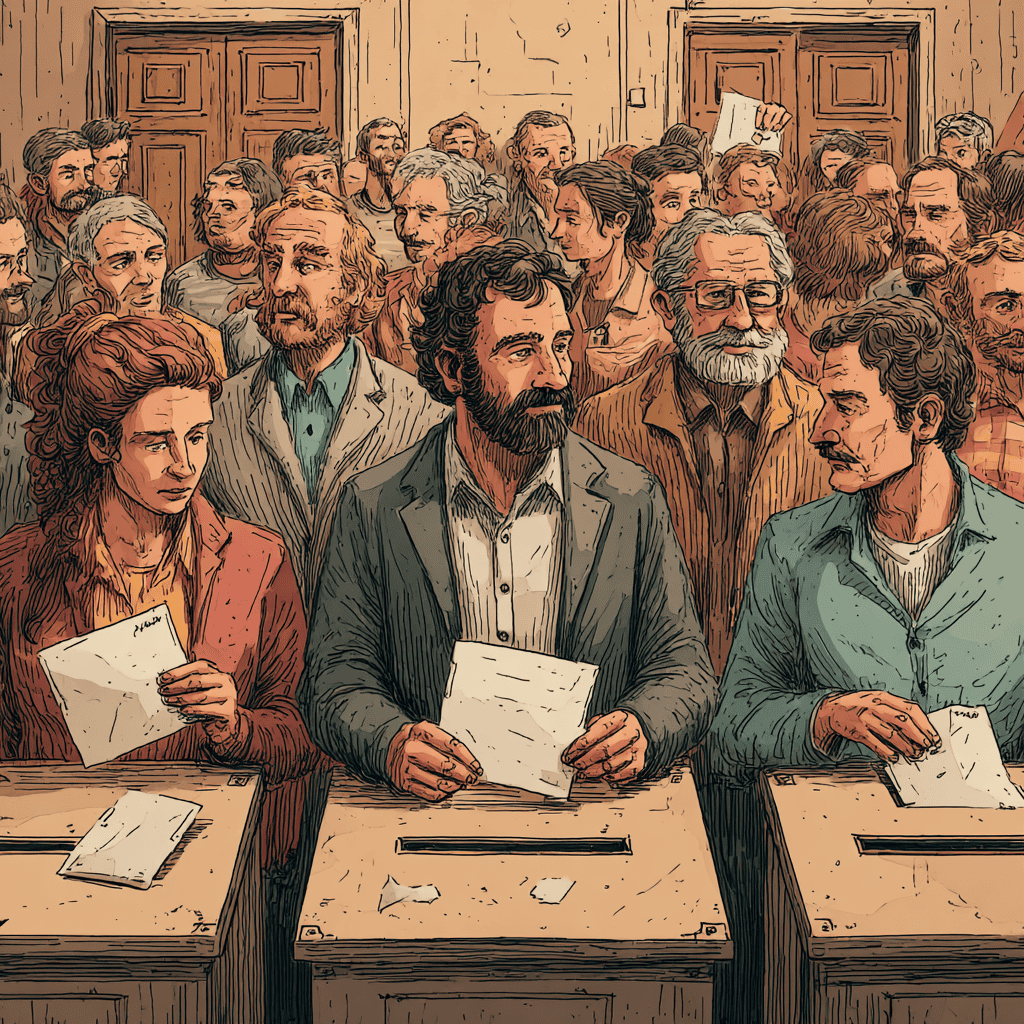
Most voters never know who these electors are—their names rarely appear on ballots. Instead, ballots show the presidential candidates’ names, with the understanding that voting for a candidate means voting for their electors.
Step 2: State-by-State Winner Determination
48 states plus D.C. use winner-take-all systems where the candidate receiving the most votes (even if not a majority) wins all that state’s electoral votes. Only two states differ:
Maine and Nebraska use a congressional district method:
- 2 electoral votes go to the statewide winner
- Remaining electoral votes are awarded by congressional district
- This can split a state’s electoral votes (as happened in Maine in 2016 and 2020, Nebraska in 2008 and 2020)
The winner-take-all system dramatically shapes campaign strategy. Winning California 50.1% to 49.9% yields the same 54 electoral votes as winning 70% to 30%. This encourages candidates to focus on competitive states while ignoring “safe” states.
Step 3: The December Electoral College Meeting
On the first Tuesday after the second Wednesday in December, electors meet in their state capitals to cast official votes. This isn’t a national gathering—there’s no single “Electoral College” meeting. Instead, 51 separate meetings occur simultaneously.
Electors cast separate ballots for President and Vice President. Most states legally bind electors to vote for their pledged candidate through various mechanisms:
- State laws requiring faithfulness (33 states plus D.C.)
- Penalties for faithless voting including fines up to $1,000
- Replacement provisions allowing parties to substitute faithless electors
- Pledge requirements before nomination
The Supreme Court’s 2020 decision in Chiafalo v. Washington upheld states’ rights to enforce elector pledges, effectively ending the already-rare phenomenon of faithless electors changing outcomes.
Step 4: Congressional Counting and Certification
On January 6th, a Joint Session of Congress counts electoral votes, with the Vice President presiding—sometimes having to announce their own defeat, as Al Gore did in 2001 and Mike Pence did in 2021.
The process typically runs smoothly, but the Electoral Count Act of 1887 (updated in 2022) provides procedures for objections:
- Objections require support from at least one-fifth of both chambers
- Each chamber debates separately for up to two hours
- Both must vote to sustain an objection to reject electoral votes
The January 6, 2021 attack on the Capitol during this normally ceremonial process highlighted the system’s vulnerability to bad-faith challenges.
Step 5: Inauguration
The winner takes office at noon on January 20th, completing the lengthy process that began with primary campaigns often two years earlier.
The Pros: Arguments for Keeping the Electoral College
Protecting Small State Influence
Electoral College supporters argue the system prevents presidential campaigns from becoming exclusively focused on major population centers. Without it, candidates might campaign only in major metropolitan areas, ignoring rural and small-state concerns.
The current system forces candidates to build geographically diverse coalitions. Winning requires appealing to farmers in Iowa, factory workers in Michigan, retirees in Florida, and tech workers in North Carolina. This geographic distribution theoretically ensures presidents consider diverse regional interests.
Small states also receive disproportionate attention relative to their populations. New Hampshire’s four electoral votes shouldn’t matter much, yet its swing-state status makes it a major campaign focus. Under a pure popular vote, candidates might ignore the 1.4 million New Hampshirites entirely.
Encouraging Broad Coalitions
The Electoral College allegedly encourages ideologically moderate candidates who can appeal across regions. To win 270 electoral votes typically requires winning some combination of liberal Northeast states, conservative Southern states, and moderate Midwest states. This theoretically pulls candidates toward the center.
The system also encourages candidates to build coalitions crossing demographic lines. A Republican must win some suburban moderates; a Democrat needs some rural conservatives. This coalition-building arguably produces presidents with broader mandates than a pure popular vote might yield.
Providing Decisive Outcomes
Electoral College margins often exceed popular vote margins, providing clear mandates and avoiding contentious nationwide recounts. In 1960, Kennedy won the popular vote by just 0.17% but secured a comfortable 303-219 electoral victory. This magnification effect can provide stability and legitimacy.
The system also contains recounts to individual states rather than requiring nationwide tallies. The 2000 Florida recount was messy enough; imagine that chaos across all 50 states. The Electoral College compartmentalizes disputes, preventing a few contested votes in California from triggering nationwide recounts.
Preserving Federalism
The Electoral College embodies federalist principles central to America’s constitutional structure. States run their own elections, set their own rules (within constitutional bounds), and maintain their significance as political units rather than mere administrative divisions.
This federalist approach allows experimentation—Maine and Nebraska’s district method, ranked-choice voting experiments, and varying early voting rules. A national popular vote might require standardizing election procedures, reducing state autonomy.
Maintaining Two-Party Stability
The Electoral College’s majority requirement and winner-take-all nature reinforce the two-party system. Third parties rarely win electoral votes, encouraging broad coalition parties rather than European-style multi-party parliaments requiring complex coalition governments.
While limiting choice, this stability means America avoids the government formation crises plaguing some democracies. Presidents enter office with clear mandates rather than owing their position to small coalition partners who extracted policy concessions.
The Cons: Arguments Against the Electoral College
Democratic Illegitimacy
The most fundamental criticism is simple: the candidate with fewer votes can win. This happened in 1876, 1888, 2000, and 2016, with Presidents Hayes, Harrison, Bush, and Trump taking office despite losing the popular vote. In 2016, Hillary Clinton received nearly 3 million more votes than Donald Trump yet lost 227-304 in electoral votes.
This violates basic democratic principle—that the majority should rule. No other democracy allows the second-place finisher to win. Governors, senators, mayors all require plurality victories; only the presidency permits popular vote losers to win.
Critics argue this undermines presidential legitimacy. How can presidents claim mandates when most voters preferred someone else? This legitimacy deficit can weaken presidents domestically and internationally.
Voter Disenfranchisement
The winner-take-all system means millions of votes effectively don’t matter. A Republican in California or a Democrat in Alabama knows their presidential vote won’t affect the outcome. This creates several problems:
Depressed Turnout: Why vote when outcomes are predetermined? Safe states see lower turnout, reducing democratic participation. In 2020, competitive Wisconsin saw 75% turnout versus 67% in non-competitive New York.
Ignored Voices: The 4.5 million Trump voters in California and 3.8 million Biden voters in Texas effectively had no say in choosing the president. Their votes vanished in the winner-take-all allocation.
Unequal Vote Value: Geography determines vote importance. A Florida voter matters enormously; a Hawaii voter barely registers. This geographic lottery violates the principle of voter equality.
Swing State Distortion
The Electoral College concentrates all campaign attention on a handful of competitive states. In 2020, 96% of campaign events occurred in just 12 states. The candidates held zero campaign events in 33 states after the conventions.
This creates perverse policy incentives:
- Florida’s elderly population drives Medicare policy
- Pennsylvania fracking interests influence energy policy
- Michigan auto workers shape trade policy
- Iowa farmers determine agricultural subsidies
Meanwhile, California’s tech industry, Texas’s energy sector, and New York’s financial industry—economically crucial—receive minimal presidential attention because their states aren’t competitive.
Minority Rule Potential
The Electoral College enables systematic minority rule through multiple mechanisms:
Senate Bias: Since every state gets two senators regardless of population, small states are overrepresented. The 20 smallest states have 40 senators representing 35 million people; California’s 40 million have just two senators. This bias transfers to electoral votes.
Gerrymandering Effects: In states using district methods (or if more adopted them), gerrymandered congressional districts could determine electoral votes, allowing minority parties to win presidencies.
Contingent Elections: If elections go to the House, each state gets one vote. The 26 smallest states representing 17% of the population could choose the president.
Suppressing Third Parties and Innovation
The Electoral College’s winner-take-all nature and majority requirement effectively ban third parties from competition. A third party winning 20% nationally but not winning any states receives zero electoral votes. This happened to Ross Perot in 1992—19% of votes, zero electoral votes.
This suppression limits choice and prevents new ideas from entering mainstream politics. It also enables the two major parties to ignore popular positions, knowing voters have nowhere else to go.
Major Controversies and Historical Crises
The 1876 Hayes-Tilden Disaster
The 1876 election nearly broke American democracy. Democrat Samuel Tilden won the popular vote by 3% and led 184-165 in electoral votes, one short of victory. Twenty disputed electoral votes from Florida, Louisiana, South Carolina, and Oregon created crisis.
Congress created a special Electoral Commission that awarded all 20 votes to Republican Rutherford Hayes on party lines. Democrats accepted this result only after Republicans agreed to end Reconstruction, abandoning African Americans to Jim Crow oppression. The Electoral College literally traded away civil rights for political peace.
The 2000 Bush-Gore Debacle
The 2000 election came down to Florida’s 25 electoral votes. After a month of recounts, lawsuits, and “hanging chad” controversies, the Supreme Court’s 5-4 decision in Bush v. Gore stopped recounts, giving Bush a 537-vote Florida margin and the presidency despite losing nationally by 544,000 votes.
This exposed the Electoral College’s vulnerability to:
- State-level manipulation through voter roll purges and ballot designs
- Judicial intervention allowing courts to determine presidents
- Arbitrary deadlines that prioritize finality over accuracy
The aftermath saw numerous election reforms but left the fundamental Electoral College structure unchanged.
The 2016 Trump-Clinton Shock
2016 demonstrated the Electoral College’s modern dysfunction. Clinton won by 2.87 million votes—the largest popular vote margin for a losing candidate ever. Trump’s 77,744-vote combined margin in Michigan, Wisconsin, and Pennsylvania delivered the presidency.
This wasn’t a fluke but reflected structural bias. Democrats increasingly concentrate in cities, “wasting” votes in landslide wins. Republicans spread efficiently across rural and suburban areas, maximizing Electoral College efficiency. This geographic sorting means Democrats need larger popular vote margins to win Electoral College majorities.
The 2020 Challenges and January 6
The 2020 election revealed new Electoral College vulnerabilities. Despite Biden’s 7 million vote margin and 306-232 electoral victory, Trump’s challenges nearly succeeded through:
- Alternate elector schemes where Republicans in seven states Biden won submitted false electoral certificates
- Pressure on state officials to “find” votes or refuse certification
- Congressional objection attempts during the January 6 counting
- Vice Presidential pressure to reject electoral votes unilaterally
The January 6 Capitol attack aimed to disrupt electoral counting, exposing how the Electoral College’s complex procedures create opportunities for subversion that wouldn’t exist under direct popular vote.
Reform Proposals and Alternatives
Abolishing the Electoral College
The most straightforward reform—constitutional amendment for direct popular vote—faces nearly insurmountable obstacles:
Amendment Requirements: Two-thirds of both House and Senate, then three-fourths of state legislatures must approve. Small states benefiting from current system can block reform.
Political Reality: 33 states have fewer than 11 electoral votes and benefit from overrepresentation. Getting 38 states to reduce their own power seems impossible.
Public opinion increasingly favors abolition—polls show 60-65% support for popular vote—but constitutional structure prevents majority will from prevailing.
National Popular Vote Interstate Compact
The National Popular Vote Interstate Compact (NPVIC) offers an end-run around constitutional amendment. States pledge their electoral votes to the national popular vote winner once states totaling 270 electoral votes join.
Current Status: 17 states plus D.C. have joined, totaling 209 electoral votes—77% of the way to activation. However, all are Democratic-leaning states. No swing or Republican states have joined, stalling progress.
Legal Questions: Critics argue the Compact violates the Constitution’s Compact Clause requiring congressional approval for interstate agreements. Supporters counter it merely exercises states’ existing power to allocate electors.
Practical Concerns: What happens if states withdraw after losing? How would recounts work? Would campaigns radically change strategies?
District-Based Allocation
Expanding Maine and Nebraska’s model nationwide would award electoral votes by congressional district plus two for statewide winners.
Advantages:
- Makes more areas competitive
- Better reflects state diversity
- Maintains federalist structure
Disadvantages:
- Gerrymandering would determine presidencies
- Could produce more popular-vote/electoral-vote splits
- Increases complexity and manipulation opportunities
Analysis suggests Romney would have won in 2012 under this system despite Obama’s 5 million vote margin, demonstrating how gerrymandering could entrench minority rule.
Proportional Allocation
States could allocate electoral votes proportionally to vote percentages. Winning 60% of Pennsylvania would yield 12 of its 20 electoral votes.
Benefits:
- Every vote matters everywhere
- Third parties could win electoral votes
- Reduces swing state dominance
Problems:
- No candidate might reach 270, throwing elections to the House
- Requires coordinated adoption to avoid disadvantaging early adopters
- Fractional electoral votes create complexity
The Congressional District Plus Method
A hybrid approach would award one electoral vote per congressional district plus bonus votes for winning states. This differs from the current district method by eliminating statewide electoral votes.
This would create 435 competitive districts plus bonus incentives for statewide campaigns. However, it would dramatically increase gerrymandering’s importance and might produce chaotic results.
Why the Electoral College Persists Despite Criticism
Structural Entrenchment
The Electoral College survives because those empowered to change it benefit from it:
Small State Senators: Senators from overrepresented states won’t reduce their influence. Wyoming’s senators won’t vote to make Wyoming irrelevant in presidential politics.
Swing State Benefits: Competitive states receive disproportionate federal spending, disaster aid, and policy attention. Why surrender this leverage?
Party Calculations: Republicans currently benefit from Electoral College bias. Why would they eliminate an advantage?
Risk Aversion
Even Electoral College critics fear unintended consequences:
Campaign Finance: Would popular vote elections become even more expensive? Would billionaires have more influence?
Recount Chaos: Would every close election trigger nationwide recounts lasting months?
Urban Dominance: Would rural areas be completely ignored under popular vote?
Extremism: Would direct democracy enable demagogues to win with passionate pluralities?
These fears—some legitimate, others exaggerated—create status quo bias.
Constitutional Reverence
Many Americans view the Constitution as sacred, making structural changes feel like sacrilege. The Electoral College, despite its flaws, carries the Founders’ imprimatur. Abandoning it feels like abandoning American exceptionalism itself.
This constitutional fundamentalism prevents pragmatic assessment. The Founders themselves expected regular constitutional updates—they’d be appalled we’ve had only 27 amendments in 235 years.
The Future of the Electoral College
Demographic Trends
Population shifts may reshape the Electoral College naturally:
Sun Belt Growth: Texas, Florida, Arizona, and Georgia are gaining electoral votes and becoming competitive. This could eliminate Republicans’ current Electoral College advantage.
Rust Belt Decline: Michigan, Pennsylvania, and Wisconsin are losing relative influence, potentially reducing their outsized importance.
Urban Expansion: Growing metro areas in previously red states (Atlanta, Phoenix, Houston) could flip states Democrats haven’t won in decades.
These shifts might make the Electoral College more representative—or entrench new biases we can’t yet predict.
Technology’s Impact
Technology could affect the Electoral College through:
Micro-Targeting: Big data allows unprecedented voter targeting, potentially making more states competitive through surgical campaigns.
Deepfakes and Disinformation: Electoral College’s state-by-state nature creates 51 attack surfaces for election manipulation.
Online Organizing: Digital tools might enable third parties to compete more effectively for electoral votes.
Blockchain Voting: Secure digital voting could increase turnout, potentially shifting state competitiveness.
Political Realignment
American politics faces potential realignment that could scramble Electoral College dynamics:
Education Polarization: If college-educated voters continue trending Democratic while non-college voters trend Republican, previous swing states might become safe while safe states become competitive.
Racial Depolarization: Hispanic voters’ rightward shift could make Southwest states competitive while Southern states with large Black populations remain safe.
Geographic Sorting: Continued urban/rural polarization might create more landslide states and fewer swing states, concentrating power in an ever-smaller number of locations.
Conclusion: Democracy’s Imperfect Compromise
The Electoral College stands as perhaps the most consequential anachronism in American democracy—a system designed for a different era, solving problems that no longer exist while creating new ones the Founders never imagined. It transforms presidential elections from national contests into state-by-state battles, elevates geography over democracy, and enables outcomes that contradict popular will.
Yet it persists, embedded so deeply in America’s constitutional structure that removal seems impossible. The very features critics condemn—small state overrepresentation, winner-take-all dynamics, indirect selection—have constituencies who benefit and will defend them fiercely. The Electoral College has become like democracy itself: the worst system except for all the others we’re too afraid to try.
Understanding the Electoral College means grappling with fundamental questions about American democracy. Should every vote count equally, or should geographic distribution matter? Is federalism worth preserving even when it contradicts majority rule? Can a democracy survive when its leaders lack popular mandates?
These aren’t merely academic questions. As America faces rising polarization, demographic transformation, and democratic backsliding globally, the Electoral College increasingly determines not just who becomes president but whether the public accepts that president as legitimate. A system that repeatedly produces popular vote losers risks undermining faith in democracy itself.
The Electoral College controversy won’t disappear because it reflects deeper tensions in American society—between urban and rural, diverse and homogeneous, majoritarian and federalist visions of democracy. Until America resolves these fundamental conflicts, the Electoral College will remain: criticized by most, reformed by none, determining presidents through an 18th-century mechanism struggling to govern a 21st-century nation.
Whether the Electoral College ultimately strengthens or weakens American democracy depends on whether Americans can reform it to reflect contemporary democratic values while preserving beneficial federalist principles. That conversation requires honest acknowledgment of both the system’s genuine benefits and its serious democratic deficits. Only through understanding can citizens make informed decisions about whether this peculiar institution deserves preservation, reform, or abolition.
The Electoral College isn’t just a quirk of American democracy—it’s a mirror reflecting our deepest tensions about what democracy should be. The question isn’t whether it’s perfect; it’s whether we can do better. That answer will shape not just future elections but the future of American democracy itself.
Additional Resources
- National Archives – Electoral College – Official federal resource on Electoral College procedures and history
- FairVote Electoral College Reform Resources – Comprehensive reform proposals and analysis
- National Popular Vote Interstate Compact – Official site tracking compact progress and arguments